
Table of content
Angle ratio x : y : z
Clear

Last update: February 25th 2026
Triangle slope is the steepness you get from a right-triangle “rise” and “run.” In the next few minutes, you’ll see the core formulas, how to switch between slope, angle, and percent grade, plus a few worked examples.
Triangle slope describes how each side leans when it’s placed on a coordinate grid. It shows how much a line goes up or down as you move one unit to the right, turning direction into a simple number you can work with.
That number tells you exactly how a triangle’s sides are positioned. A positive slope climbs from left to right, a negative slope drops, a slope of 0 stays flat, and an undefined slope means the side is perfectly vertical.
Slope is also closely tied to angles. If a side makes an angle θ with the horizontal axis, its slope is equal to tan(θ). Because of this, slope works as a compact way to describe direction without needing to measure the full length of the side.
.jpg)
Slope can sound a bit “mathy,” but it really comes down to a few simple formulas. Below, you’ll see the main ways to find a triangle side’s slope—using two points, an angle, or the rise-and-run legs of a right triangle—with quick visuals to make it easier to picture.
1. Two-point slope
If a triangle side passes through two points P₁(x₁, y₁) and P₂(x₂, y₂), slope is based on the change in y compared to the change in x: Slope = (y₂ − y₁)⁄(x₂ − x₁) same idea written as: m = Δy⁄Δx
This single formula covers almost everything you do with triangle sides on a graph: finding slopes, comparing which side is steeper, or checking whether two sides are parallel.
Quick slope “signals” to remember:
If Δy = 0, the side is perfectly horizontal → m = 0
If Δx = 0, the side is perfectly vertical → slope is undefined (because you can’t divide by 0)
.jpg)
2. Angle form
Sometimes you don’t start with two points — you start with an angle. If a side makes an angle θ with the positive x-axis, its slope is:
Slope = tan(θ)
This is useful because it turns direction (an angle) into a slope value instantly. In other words, tangent is the “translator” between angle and slope.
A nice way to think about it: as θ increases from 0° to 90°, the line tilts upward more and more, and the slope grows from 0 toward something extremely large (and becomes undefined exactly at 90°, because that’s vertical).
3. Right-triangle ratio
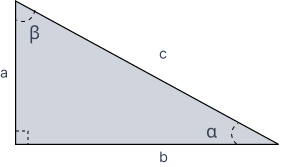
Any slanted side can be paired with a right triangle by dropping a vertical and horizontal step. That creates the classic “slope triangle,” where slope becomes a clean side-length ratio:
Slope = opposite⁄adjacent
This is basically the same concept as Δy⁄Δx, just expressed as triangle legs instead of coordinate differences.
This form is especially handy when you’re working with right triangles or when a problem gives you side lengths instead of coordinates. It also makes it easier to switch between:
Slope as a ratio (opposite⁄adjacent)
Trigonometry (tan(θ))
Coordinate changes (Δy⁄Δx)
🧠 Fun fact: Any line with slope 1 makes a perfect 45° angle with the x-axis—so if a triangle side has slope 1, it often creates a super “balanced” right-triangle feel.
And when you get into bigger ideas—perpendicular slopes, rotated triangles, or spotting the steepest side—they all trace back to one of the formulas above.
.jpg)
Think of slope as a quick “tilt score” for each side. For any side connecting two points (x₁, y₁) and (x₂, y₂), its slope is:
m = (y₂ − y₁)⁄(x₂ − x₁)
Now you can compare triangle sides without measuring lengths—just compare their slopes.
When you want to know which side is steepest, look at |m|:
|m|> 0 → steeper side
|m|< 0 → flatter side
|m|= 0 → perfectly horizontal
Example (visual in numbers):
Side A: m = 3 → |m| = 3 (very steep)
Side B: m = −1 → |m| = 1 (less steep)
Side C: m = 0 → |m| = 0 (flat)
So Side A tilts the most, even though Side B slopes downward.
The sign tells you which way the side “walks” as you move left → right:
m > 0 : rises ↗
m < 0 : falls ↘
m = 0 : flat →
This is helpful when two sides have similar steepness but mirror each other, like m = 2 vs m = −2 (same steepness, opposite direction).
Horizontal vs vertical
Horizontal sides: m = 0 (least steep)
Vertical sides: undefined slope (because x₂ − x₁ = 0), which you can think of as “steepness → infinity” and it forms a 90° angle with the x-axis.
🧠 Fun fact: If two sides have the same slope (like
m = ¹⁄₂andm = ¹⁄₂), they’re parallel—even if they’re in different triangles. Slope alone is enough to prove parallel lines on a coordinate plane.
Overall, comparing slopes is a fast, visual way to spot the steepest edge, see which sides tilt in opposite directions, and check relationships like parallel sides—right from the numbers
.jpg)
Slope ties straight to a side’s angle from the horizontal:
m = tan(θ)
So every slope value is basically an “orientation label” on the coordinate plane. And when two sides meet, the difference in their slopes often hints at how wide the interior angle is—very different slopes usually create a sharper-looking corner than two slopes that are close.
A big shortcut for spotting right triangles is the perpendicular-slope rule:
m₁ · m₂ = −1
If two sides meet and their slopes multiply to −1, they’re perpendicular—meaning that vertex is a 90° angle. You can confirm a right triangle from slope data alone, without measuring side lengths.
Slope patterns can also suggest triangle type by symmetry:
If two slopes are opposites, like m and −m, those sides are mirror-tilts (one rises, the other falls at the same rate). That kind of “balanced” tilt sometimes shows up in isosceles-looking setups on a grid.
If all three sides have clearly different slopes, the triangle usually looks scalene in orientation (no matching tilt directions).
Overall, slope + angle relationships give you a compact, visual way to classify how a triangle “sits” on the coordinate grid—even before you get into exact side lengths.
Is triangle slope the same as line slope?
Yes. A “slope triangle” is just a visual way to measure a line’s slope using rise and run, so the slope is still m = rise⁄run.
What do “rise” and “run” mean?
rise is the vertical change (Δy), and run is the horizontal change (Δx). Put them together as m = Δy⁄Δx.
How do I find slope from two points?
Use m = (y₂ − y₁)⁄(x₂ − x₁). Keep the order consistent: if you do (y₂ − y₁), then do (x₂ − x₁) the same way.
Can slope be negative? What does that look like?
Yep. A negative slope means the line goes downward as you move left to right. In rise/run terms, it’s like a positive run with a negative rise, so m = (−rise)⁄run.
What happens if the run is 0?
That’s a vertical line. Since m = rise⁄run, you’d be dividing by 0, so the slope is undefined.
Can slope be bigger than 1?
Definitely. If the rise is larger than the run (like m = 3⁄2), the line is just steeper.
How do I convert slope to an angle?
Slope connects to the angle θ through tangent: m = tan(θ). To go the other way, use θ = arctan(m).
How do I convert slope to percent grade?
Percent grade is slope written as a percent: grade% = 100 × rise⁄run. Since m = rise⁄run, you can also use grade% = 100 × m.
Is “gradient” the same as “slope”?
In most school math, yes—people use them interchangeably. You’ll often hear “gradient” more in UK-style wording, but the math is the same m = rise⁄run.
Does it matter which slope triangle I draw on the same line?
Not really. Any right triangle you draw along the same straight line will give the same ratio rise⁄run (as long as it follows the line), so the slope stays the same.
Edited by: JetCalculator Editorial Team
All content is compiled and verified by our editors and subject-matter contributors, based on reliable and authoritative sources.
For verification requests, please contact: [email protected].
